


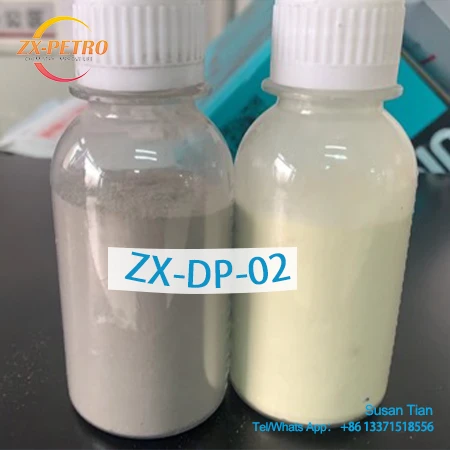
General Description
High-efficiency emulsion gelling agent designed for acidizing systems, enabling stable acid emulsions, deeper reservoir penetration, and controlled reaction rates - helping service companies improve stimulation results while reducing operational risks and acid consumption. Emulsion gelling agent is a specialized surfactant-polymer compound used in acidizing operations to form stable acid-in-oil emulsions. It transforms conventional acid fluids into high-viscosity systems, slowing acid-rock reaction rates and improving treatment depth. Developed using advanced emulsion stabilization technology, this product is suitable for carbonate reservoir stimulation and compatible with various acid systems, including hydrochloric acid and organic acid blends.
Product Advantages
1. Controlled Acid Reaction Rate
The agent forms a stable emulsion structure that encapsulates acid droplets, reducing direct
contact with the formation.
→ Why it matters: Slower reaction allows acid to penetrate deeper into the reservoir instead of reacting near the wellbore.
→ Business benefit: Better stimulation results = higher client satisfaction.
2. High Emulsion Stability Under Harsh Conditions
Designed to maintain emulsion integrity under high temperature and high salinity conditions.
→ Why it matters: Prevents premature emulsion breaking during pumping.
→ Business benefit: Reduces treatment failure risks in complex reservoirs.
3. Enhanced Viscosity & Fluid Control
The system increases fluid viscosity, improving diversion and fluid placement.
→ Why it matters: Better coverage of target zones.
→ Business benefit: Maximizes efficiency of each acid job.
4. Reduced Acid Consumption
By improving acid utilization efficiency, less acid is required for the same stimulation effect.
→ Business benefit: Direct cost savings and safer operations
Properties
| Appearance | Milky white liquid |
Application
Acidification is an effective reservoir modification measure for increasing production of wells and increasing wells. The principle is to inject acid into the well below the fracture pressure of the rock, and the acid is squeezed into the pore space around the near-wellbore. Through dissolution and dissolution of acid liquids on rock cements or formation pores, plugs in cracks, etc., the rocks in the acid intrusion belt are successively dissolved, forming channels that help the seepage of oil and water and restore the permeability of the formation. Conventional acid systems are usually hydrochloric acid or soil acid + acidification corrosion inhibitor + iron ion stabilizer + drainage agent + clay stabilizer + anti-milk - demulsifier +anti-sludge agent, when using conventional acid system for acidification, The reaction between the acid system and formation rock is too fast, the action distance of the acid system is short, and the depth of penetration is small, often failing to achieve the intended purpose. Slowing the reaction rate between the acid and the formation is an important issue for increasing the radius of
the acid treatment and improving the acidification effect. Increasing the viscosity of the acid liquid can reduce the loss of fluid and slow down the activity of hydrogen ions. It is the most effective
retarding method and is the most effective means to deal with carbonate reservoirs at home and abroad.
Thickening acid system
The thickened acid system was a 2% cationic emulsion polymer thickener added to a conventional acid system. After adding 2% cationic emulsion polymer thickener, the cost per ton of acid solution system is increased by about 500 yuan/t compared with the conventional acid solution system. However, in the acidification operation, the same amount of acid is used to apply the same. The acid treatment radius of the thickened acid system can be increased several times compared to the acid treatment radius of the conventional acid liquid system, and the acid treatment area can be increased by more than ten times.
The thickening acid system is a polymer acid solution, has a higher viscosity, and has the following advantages compared with the conventional acid liquid system:
1. The acid rock has a low reaction speed, prolongs the dissolution time of the acid in the formation, and increases the acidity. Working distance;
2, Low rate of acid fluid filtration, high rate of effective use of the acid;
3, Low frictional resistance of the pipeline;
4, Shear resistance, good stability at high temperature;
5,Degradation does not produce harmful residues;
6, Thickening acid The system can be used not only for matrix acidification but also for acid pressure construction.
Indoor evaluation of thickening acid system
According to the standard SY/T6214-1996 "acid thickener evaluation method" on the thickening acid system made an indoor evaluation:
1,Thickener acid dissolution time
The thickener was first added to 20% hydrochloric acid in 2% increments and placed in a rotating viscometer drum at room temperature to be stirred and dissolved (170s-1). The viscosity of the acid solution was measured at different times until the viscosity of the acid was stable. , record the minimum time when the acid viscosity is stable.
| Time(min) | Viscosity(mPa.s) |
| 0 | 3.6 |
| 5 | 27.4 |
| 10 | 41.3 |
| 15 | 49.5 |
| 20 | 53.7 |
| 25 | 55.6 |
| 30 | 56.4 |
| 35 | 57.1 |
| 40 | 57.1 |
According to the data in the above table, the thickening agent has good dispersibility in the acid solution, and the viscosity of the acid solution increases rapidly after the thickening agent is added to the acid solution. After about 35 minutes, the viscosity of the acid solution tends to be stable, indicating that the thickener has been completely dissolved in the acid solution. The quick-solubility of the thickener helps shorten the acid
Working hours.
2,Thickness acid system thermal stability
The prepared thickened acid system was heated to 30°C and then kept at a constant temperature for 5 minutes. The viscosity of the thickened acid was measured at 170 s-1. The thickened acid system was then placed in a 500 mL jar with a condensing device and heated to 60°C, take out after constant temperature 240min, natural cooling to 30 ° C, test the viscosity of the acid at
170s-1:
| 30°C viscosity (mPa.s) | Viscosity (mPa.s) after constant temperature of 90°C for 4 hours | Thermal stability (%) |
| 57.1 | 35.9 | 62.5 |
The viscous acid system can maintain its viscosity at 35.9 mPa.s after being heated at 90°C for 240 minutes. It has good thermal stability, which is conducive to the smooth progress of acidification construction.
3,Thickening acid system shear stability
The thickened acid system was thermostated at 30°C and continuously sheared with a rotational viscometer at this temperature. The shear rate was 170 s-1 and the continuous shear time was 120 minutes. The annual data of the acid system was recorded every 20 minutes:
| Cutting time (min) | Viscosity(mPa.s) |
| 0 | 57.2 |
| 20 | 56.7 |
| 40 | 56.1 |
| 60 | 55.3 |
| 80 | 54.5 |
| 100 | 53.8 |
| 120 | 53.1 |
The viscous acid system can still maintain its viscosity at 53.1 mPa.s after 120min continuous shearing, indicating that the thickened acid system has good shear stability.
4,Slow speed performance of thickened acid system
Configure the conventional acid system and the thickening acid system respectively into a 500-mL wide-mouth bottle. Add a 4×2×2 cm marble block in a constant-temperature water bath at 90 ° C. for 30 minutes and record the start time. No bubbles are found in the acid solution. Escape for the termination time, according to the formula R = (t'-t1) / (t'2-t2) calculated thickening acid system extended time multiple:
|
Reaction time with marble block(s)
|
|
| Conventional acid system | 683 |
| Thickening acid system | 1972 |
According to the formula above, the polycondensation time of the thickened acid system is 2.887 times, which indicates that the thickened acid system has good slow-speed performance. In field applications, the thickened acid system can greatly increase the acidification treatment radius compared to conventional acid systems.
In conclusion
1. The thickening acid system of ZhuoYu Energy Science And Technology Co.,Ltd. can effectively delay the acid-rock reaction rate, thereby increasing the acid treatment radius during acidification and improving the acidification effect.
2. The thickening acid system of ZhuoYu Energy Science And Technology Co.,Ltd. has good temperature resistance performance. The residual acid's viscosity and surface tension are very low, which is conducive to the backflow of residual acid.
Packaging and storage
1. Packing: Iron or plastic drum, IBC tanks, or per clients request with clients' logo;
2. Storage: Stay away from fireworks, place in a ventilated place, light loading and discharging, prevent the breakage of package;
3. Shelf lift is 2 year.
CTA
Hot Tags: emulsion gelling agent, China emulsion gelling agent manufacturers, suppliers, factory