

Quality control standards for reverse demulsifiers are of utmost importance in ensuring their effectiveness and reliability in various industrial applications. As a supplier of reverse demulsifiers, we understand the critical role these standards play in meeting the diverse needs of our customers. In this blog, we will delve into the key quality control standards for reverse demulsifiers and how they contribute to the overall performance of these essential chemical agents.
1. Chemical Composition and Purity
The chemical composition of a reverse demulsifier is the foundation of its performance. It is essential to precisely define and control the types and proportions of active ingredients. Different applications may require specific chemical structures to break emulsions effectively. For example, in the oil - and - gas industry, where emulsions are formed between crude oil and water, the reverse demulsifier should have the appropriate hydrophobic and hydrophilic groups to interact with the oil - water interface.
Purity is another crucial aspect. Impurities in a reverse demulsifier can not only reduce its demulsification efficiency but also cause adverse effects in the system. They may lead to corrosion, fouling, or other operational problems. Our company adheres to strict purity standards, ensuring that the reverse demulsifiers we supply are free from contaminants such as heavy metals, acids, and bases that could potentially interfere with the demulsification process.
2. Demulsification Efficiency
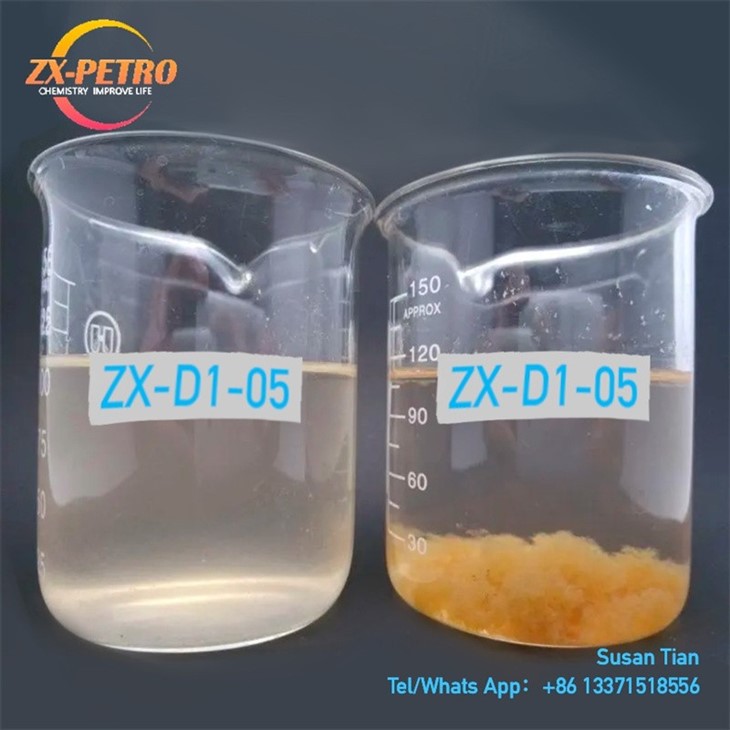
The primary function of a reverse demulsifier is to break emulsions. Therefore, demulsification efficiency is a core quality control standard. This can be measured by various laboratory tests. One common method is the bottle test, where a sample of the emulsion is mixed with the reverse demulsifier in a sealed bottle. After a certain period of time, the separation of the oil and water phases is observed, and the degree of separation is measured.
The efficiency is often expressed as the percentage of water separation or the decrease in the volume of the emulsion layer. For our products, we conduct rigorous testing to ensure that they meet or exceed the industry - accepted demulsification efficiency benchmarks. This guarantees that our customers can achieve rapid and effective separation of oil and water in their processes, reducing processing time and costs.
3. Stability
Reverse demulsifiers need to be stable under different storage and operating conditions. They should not degrade or undergo chemical reactions that could alter their performance. Temperature stability is particularly important, as many industrial processes operate at elevated or low temperatures. Our reverse demulsifiers are tested to ensure they maintain their efficacy within a wide temperature range.
In addition to temperature, the stability of the demulsifier in the presence of other chemicals in the system is also critical. Compatibility tests are carried out to ensure that the reverse demulsifier does not react negatively with other additives or components in the emulsion, such as corrosion inhibitors, scale inhibitors, or surfactants.
4. Solubility
The solubility of a reverse demulsifier is an important quality factor, especially in oil - based systems. It should be able to dissolve quickly and uniformly in the oil phase to ensure effective contact with the emulsion - droplets. For applications that require an oil - soluble demulsifier, we offer products like the Demulsifier oil soluble type, which are formulated to have excellent solubility in various oils.
In some cases, where the emulsion contains a high percentage of water or has a complex composition, a universal oil - soluble demulsifier may be required. Our Universal oil - soluble Demulsifier is designed to be effective in a wide range of emulsion types and can dissolve readily in different oil matrices.
5. Environmental and Safety Standards
In today's environmentally conscious world, reverse demulsifiers must meet strict environmental and safety standards. They should be biodegradable to minimize their impact on the environment after use. Our company is committed to developing and supplying reverse demulsifiers that are environmentally friendly, reducing the ecological footprint of our customers' operations.

Safety is also a top priority. The reverse demulsifiers we provide are tested for toxicity, flammability, and other safety - related parameters. They come with clear labels and safety data sheets to ensure proper handling and storage, protecting the health and safety of workers in the industries that use our products.
6. Consistency and Reproducibility
Consistency is essential in the production of reverse demulsifiers. Each batch of the product should have the same chemical composition, performance characteristics, and quality. Our manufacturing processes are carefully monitored to ensure that every unit of the reverse demulsifier that leaves our facility meets the same high - quality standards.
Reproducibility of the manufacturing process is also crucial. We use advanced technologies and quality control systems to ensure that we can reproduce the same product consistently over time. This gives our customers the confidence that they will receive a reliable and effective product every time they place an order.
7. Performance in Different Emulsion Systems
Emulsions can vary greatly in terms of their composition, stability, and the nature of the oil and water phases. A high - quality reverse demulsifier should be able to perform effectively in different emulsion systems. We conduct extensive research and development to test our products in a variety of emulsion types, including those with high - viscosity oils, heavy - metal - contaminated emulsions, and emulsions with different salinity levels.
For example, in the case of extra - thick crude oil, special demulsifiers are required to break the stable emulsions formed. Our Extra Thick Crude Oil Demulsifier has been specifically developed to address the challenges posed by these types of emulsions, providing efficient separation even in the most demanding conditions.
Conclusion
As a supplier of reverse demulsifiers, we recognize that meeting the highest quality control standards is essential for the success of our customers. Our commitment to quality is reflected in every aspect of our product development, manufacturing, and testing processes. By adhering to strict standards for chemical composition, demulsification efficiency, stability, solubility, environmental and safety, consistency, and performance in different emulsion systems, we ensure that our reverse demulsifiers are reliable, effective, and environmentally friendly.
If you are in need of high - quality reverse demulsifiers for your industrial processes, we invite you to contact us for a detailed discussion. Our team of experts is ready to provide you with the best solutions tailored to your specific requirements. Let's work together to achieve efficient and cost - effective emulsion separation in your operations.
References
- Smith, J. (2020). Principles of Demulsification in the Oil and Gas Industry. Journal of Petroleum Science.
- Johnson, A. (2019). Advances in Reverse Demulsifier Technology. Chemical Engineering Review.
- Brown, C. (2018). Environmental Considerations in the Use of Demulsifiers. Environmental Science Journal.